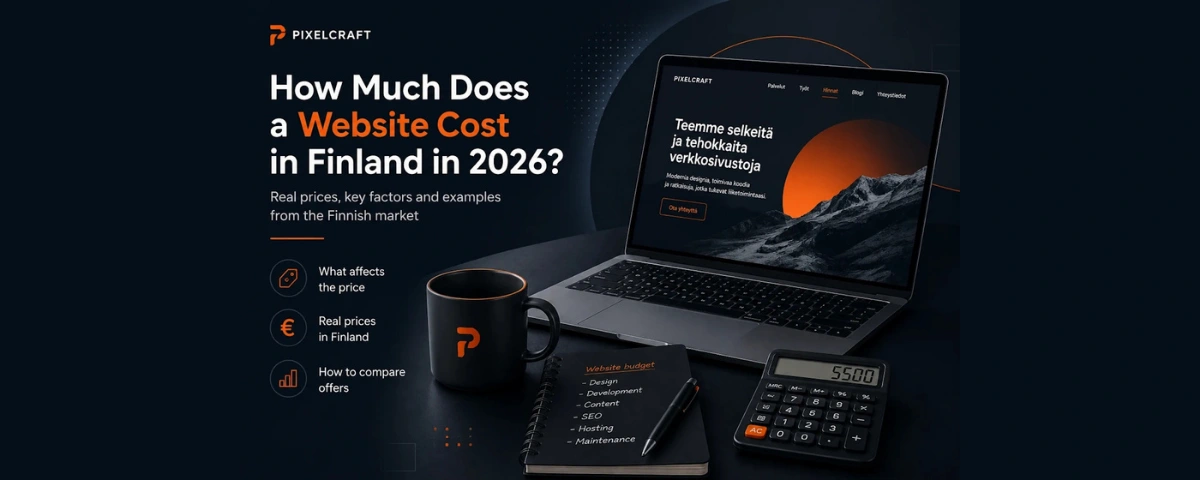

If you start comparing website development prices in Finland, you will quickly find offers ranging from a few hundred euros to several thousand. More complex projects can easily exceed €10,000.
Yet all of these services may be described simply as “website development”.
Why is there such a large difference?
Because a website is not a standardised product. Two projects that appear similar on the surface may involve very different amounts of planning, UX design, visual design, development, content creation, SEO, integrations, testing and ongoing support.
So instead of asking only “How much does a website cost?”, a more useful question is:
“What exactly is included in that price?”
How much does a website cost in Finland in 2026?
There is no single market price for website development in Finland.
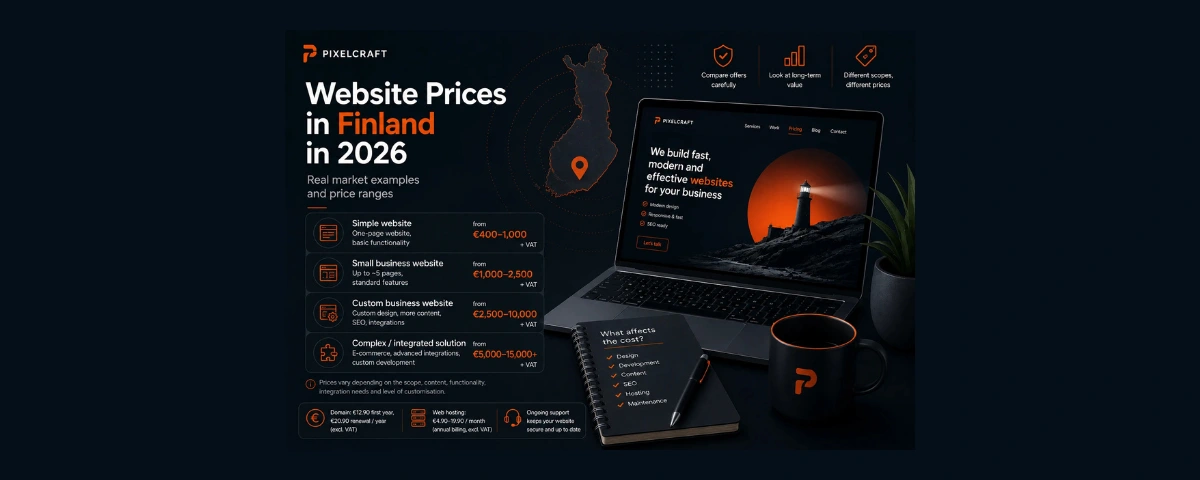
Looking at publicly available price lists from Finnish web developers and small digital agencies, simple professional websites can be found starting from several hundred euros.
Public offers include one-page websites below or around €1,000, small business websites in the region of €1,000–€2,500, and more comprehensive projects starting from several thousand euros.
Finnish companies that publish broader guides to website pricing show an even wider range. Some estimate a professionally built company website at approximately €1,000–€10,000, while broader market estimates can extend from around €500 to €15,000.
These figures are not official market statistics or a universal price list. They are indicative ranges based on publicly available offers and pricing guides published by Finnish web service providers.
More importantly, these prices do not necessarily represent the same product.
One offer may include a ready-made technical foundation, a few pages and content supplied entirely by the client. Another may include research, UX planning, custom design, content production, development, SEO, integrations, analytics, testing and post-launch support.
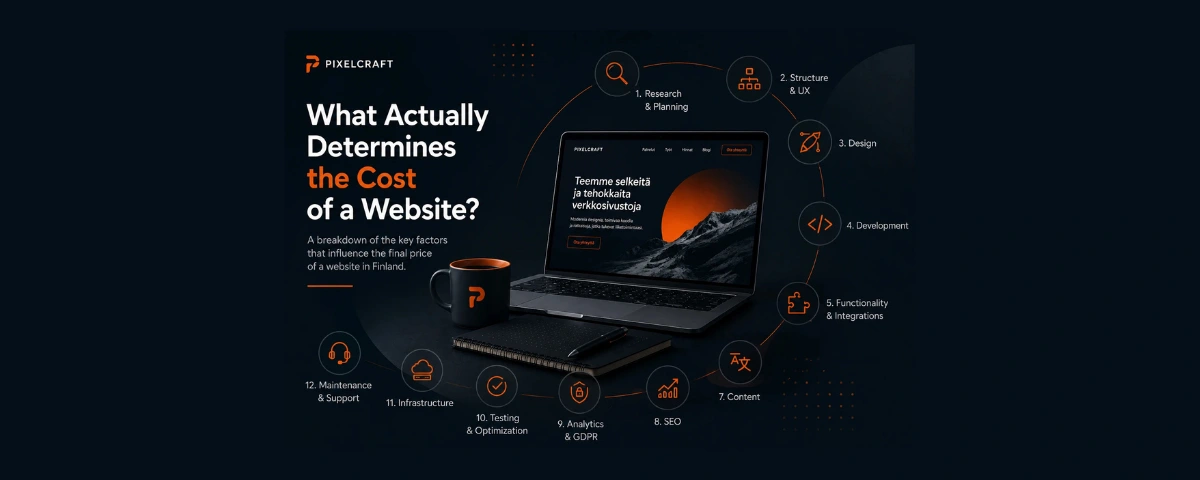
What actually determines the cost of a website?
The cost of professional website development can roughly be divided into several areas:
- research and planning;
- site structure and UX;
- visual design;
- technical development;
- functionality and integrations;
- content;
- multilingual implementation;
- SEO;
- analytics, cookies and GDPR;
- testing and optimisation;
- infrastructure;
- ongoing maintenance and support.
In a small project, several of these stages may be simplified or combined. In a larger project, each area may involve a different specialist.
This is why comparing only the final price often tells you very little about the actual value or scope of an offer.
1. Research and planning
Before designing a website, it is important to understand why the business needs it in the first place.
Who will visit it?
What information are they looking for?
What should a visitor do — call, submit an enquiry, book an appointment, purchase a product or request a quote?
For a small website, this stage may be relatively straightforward. Larger projects may involve competitor research, keyword research, content planning, customer journeys and conversion paths.
The more strategic work required before development begins, the more time becomes part of the project cost.
2. Site structure and UX
The number of pages affects the price, but it does not determine it on its own.
Consider two five-page websites.
The first contains standard sections:
- Home;
- Services;
- About;
- Contact;
- Contact form.
The second requires service categories, several types of forms, different customer journeys, more complex navigation and multiple types of content.
Both may technically contain five pages, but the amount of UX planning required is completely different.
Page count is therefore useful for an initial estimate, but it is a poor measure of the actual complexity of a website.
3. Custom design or a ready-made solution
Another factor is how much of the visual design is created specifically for the project.
The most cost-effective approach is often an existing template or design system adapted to the company's brand.
The next level may use an established technical foundation while the pages and components themselves are designed specifically for the business.
The most labour-intensive option is a fully custom interface created around the brand, content and user journeys.
None of these approaches is automatically good or bad.
For a small business, a well-adapted template can sometimes be a much more sensible investment than an expensive bespoke design.
What matters is that the client understands what level of design work they are paying for.
4. Technical development
Once the structure and design are ready, they need to be turned into a working website.
A website may be built:
- with a website builder;
- with WordPress or another CMS;
- using a ready-made theme;
- with custom frontend development;
- as a more advanced web application with both frontend and backend functionality.
The chosen technology affects the amount of work, future development options and maintenance requirements.
However, the technology itself is not a measure of quality.
WordPress can be used for a small, straightforward website or for a large custom project. The same applies to other technologies.
The more important question is whether the technical solution is appropriate for the needs of the business.
5. Functionality and integrations
This is often where a simple business website becomes a significantly larger project.
Additional functionality may include:
- online booking;
- e-commerce;
- online payments;
- customer accounts;
- CRM integrations;
- ERP integrations;
- third-party APIs;
- search and filtering;
- product or service catalogues;
- calculators;
- maps;
- automated data transfers;
- marketing platform integrations.
A basic contact form and a website connected to several external business systems are very different development tasks.
This is another reason why comparing websites only by the number of pages can be misleading.
6. Content: copy, photography and graphics
Content is easy to overlook when comparing quotes.
Some developers expect the client to provide finished:
- copy;
- photographs;
- logo files;
- translations;
- service information;
- legal texts.
Other projects include some or all of this work.
If the project requires copywriting, professional photography, illustrations, image editing or custom graphics, these tasks add to the overall scope.
Two quotes for apparently similar websites can therefore differ substantially simply because one assumes that all content is supplied by the client while the other includes content production.
7. Multilingual websites
This is particularly relevant in Finland.
A business may need its website in Finnish, Swedish, English, Russian or several languages at the same time.
Adding another language is not always a matter of simply copying a page and replacing the text.
A multilingual implementation may require:
- a suitable URL structure;
- language switching;
- translated interface elements;
- localised metadata;
- separate content versions;
- layout checks for different text lengths;
- search optimisation for each language;
- technical connections between alternative language versions.
If translation itself is also provided by the developer or another specialist, that creates an additional cost.
A multilingual website therefore usually requires more work than an otherwise identical single-language site.
8. SEO — what does “SEO included” actually mean?
The phrase “SEO included” can describe very different levels of work.
At a basic level, it may refer to technical foundations such as:
- a logical heading structure;
- title tags and meta descriptions;
- a sitemap;
- robots.txt;
- correct indexability;
- sensible internal page structure.
A more extensive SEO project may include keyword research, competitor analysis, landing-page planning, content optimisation, structured data and ongoing work to improve organic visibility.
That represents a much larger scope.
So when comparing offers, a better question than “Is SEO included?” is:
“Which SEO tasks are actually included?”
9. Analytics, cookies and GDPR
A commercial website will often need analytics and consent-management tools.
These may include:
- Google Analytics;
- Google Search Console;
- conversion tracking;
- Consent Mode;
- a cookie consent management system.
There are also different levels of implementation here.
A banner that simply appears on the screen is not the same as a consent solution that actually controls analytics and marketing technologies according to the user's choices.
Configuring and testing these systems also requires time.
10. Testing and optimisation
Website development does not end when the finished page visually matches the design.
Before launch, a professional website should be checked across areas such as:
- mobile devices;
- different screen sizes;
- browsers;
- forms;
- links;
- images;
- loading performance;
- errors;
- metadata;
- search-engine indexability;
- basic accessibility.
The higher the requirements for testing, performance and quality assurance, the more work this stage requires.
11. Domain, hosting and other ongoing costs
The development fee is not the only cost of owning a website.
After launch, there may also be recurring costs for:
- the domain name;
- hosting or server infrastructure;
- software licences;
- premium plugins;
- CMS or SaaS services;
- email services;
- backups;
- technical maintenance.
For example, as of August 2026, one Finnish provider lists the regular price of a .fi domain at €12.90 for the first year, with renewal at €20.90 per year, excluding VAT.
The same provider offers conventional web hosting at approximately €4.90–€19.90 per month with annual billing, excluding VAT, depending on the package.
These are examples from one provider, not average Finnish market prices. Costs from other hosting companies — and especially VPS, cloud or specialised infrastructure — can be different.
When requesting a website quote, it is therefore useful to ask not only how much the website costs to build, but also how much it will cost to operate after launch.
12. Maintenance and support after launch
A website continues to require attention after it goes live.
This is particularly relevant for CMS-based websites and e-commerce platforms, where the system, plugins and dependencies may need to be updated and security and backups need to be maintained.
Support may:
- be included in the original project;
- be provided for a limited period after launch;
- be charged as a monthly service;
- be billed according to the time actually used.
A low initial development price does not therefore always mean a low total cost of ownership over several years.
Why can one website cost €800 and another €8,000?
Imagine two companies that both need a five-page website.
On paper, the projects appear identical.
In the first project, the client provides the logo, photographs and finished copy. The site uses an existing structure, reusable components and a simple contact form.
In the second project, the provider:
- researches competitors;
- plans the information architecture;
- creates a custom design;
- helps produce the content;
- builds several language versions;
- integrates a CRM;
- configures analytics;
- carries out SEO work;
- tests performance;
- provides support after launch.
The number of pages has not changed.
The amount of work has.
This is why page count alone cannot determine the real cost of a website.
Examples of publicly available website prices in Finland
A few publicly published Finnish offers help illustrate the range.
Prices were checked in August 2026.
| Example | Published price |
|---|---|
| Kivamedia — One Page | €990 + VAT |
| Kivamedia — company website, up to 5 pages | €1,990 + VAT |
| Kivamedia — 6–12 pages or integrations | from €3,490 + VAT |
| Pohja Studio — general estimate for a professionally built company website in Finland | typically €1,000–€10,000 |
| Meio — published general price range | approximately €500–€15,000 |
These figures should not be interpreted as prices for identical products.
For example, Kivamedia's published €1,990 package includes up to five responsive pages, work on the content structure, editing of copy supplied by the client, technical SEO, structured data and preparation of analytics and Search Console.
Hosting, paid licences, photography, translations and separately agreed integrations are not included in that price.
Differences like these are exactly what should be examined when comparing website quotes.
Freelancer, small studio or digital agency?
The business model of the provider also affects the price.
Independent professional
An independent developer usually has lower administrative overheads. One person may handle design, development and project management.
For smaller projects, this can result in a lower overall price.
At the same time, one person's capacity is naturally limited by their skills and available time.
Small studio
A small studio sits somewhere between a freelancer and a large agency. Several specialists may work on a project while the organisational structure remains relatively lean.
Digital agency
An agency project may involve:
- a project manager;
- UX/UI designer;
- developer;
- copywriter;
- SEO specialist;
- photographer;
- marketing specialist.
The client is therefore paying not only for development hours but also for the work of the wider team, project management and the agency's infrastructure.
A higher agency price does not automatically mean that the price is excessive — just as a lower freelancer price does not automatically mean lower quality.
They are different ways of delivering the service.
How to compare website quotes properly
If one provider offers a website for €900 and another quotes €3,000, comparing those two numbers alone tells you very little.
Instead, check what each offer includes:
| Question | What to clarify |
|---|---|
| Design | Custom design or an existing template? |
| Structure | Who plans the pages and user journeys? |
| Content | Who writes the copy and prepares the images? |
| Responsive design | Is full mobile adaptation included? |
| CMS | Will you be able to edit the website yourself? |
| SEO | Which specific SEO tasks are included? |
| Analytics | Which systems will be configured? |
| GDPR | How is cookie consent implemented? |
| Languages | What is included in an additional language version? |
| Integrations | Which external services are connected? |
| Hosting | Who pays for it and what will it cost later? |
| Support | What happens after the website is launched? |
| Ownership | Who owns the domain, content and development deliverables? |
Only after answering these questions can two offers be compared more meaningfully.
When is an inexpensive website a sensible choice?
A low price is not automatically a disadvantage.
A new or small business may genuinely need only a straightforward website that:
- explains its services;
- presents previous work;
- provides contact information;
- allows potential customers to send an enquiry.
In that situation, paying for complex architecture or functionality that the business does not need may make little sense.
What matters is understanding the limitations of the chosen solution and whether it can support the business as its needs develop.
When does it make sense to invest more?
A larger budget becomes more reasonable when the website needs to function as an important business tool.
For example, when it needs to:
- consistently attract customers through search engines;
- serve several languages or markets;
- accept online payments;
- manage a large catalogue;
- integrate with internal business systems;
- automate processes;
- support complex customer journeys.
At that point, the project is no longer simply about creating a set of pages. The website becomes part of the company's digital infrastructure.
How much does PixelCraft charge?
At this point it is useful to separate the wider Finnish market from the pricing of one specific provider.
PixelCraft works primarily with small businesses, entrepreneurs and independent professionals who do not necessarily need the scale of a large digital agency.
For example, a simple one-page website from PixelCraft starts at €490 + VAT.
Larger projects are priced according to the site structure, functionality, number of languages, content requirements and chosen technology.
Importantly, €490 is a PixelCraft price. It is not the “minimum price of a website in Finland” and it is not a Finnish market average.
Current packages and their contents are available on the pricing page.
Frequently asked questions
What is the average cost of a small business website in Finland?
There is no reliable single average.
Public offers include simple websites below €1,000, small business projects costing several thousand euros and significantly more expensive custom development.
Some Finnish companies use approximately €1,000–€10,000 as a general range for professionally developed business websites, while other published estimates are wider.
It is therefore more useful to compare the scope of individual offers than to rely on an abstract average.
Why do website development prices vary so much?
Because the scope varies.
One project may involve adapting an existing foundation and publishing content supplied by the client.
Another may include research, UX, custom design, development, content production, SEO, analytics, integrations and ongoing support.
Do I need a custom-designed website?
Not necessarily.
For a small business, a high-quality template or reusable design system may be a perfectly sensible solution.
Custom design becomes more valuable when distinctive branding, an unusual structure or a specific user experience is important to the project.
Is hosting included in website development?
That depends on the provider.
Some companies include hosting in a recurring service fee, while others expect the client to purchase and manage it separately.
This should be clarified before the project begins, together with other recurring costs.
Can I start with a small website and expand it later?
In many cases, yes — provided that future development has been considered in the original architecture.
However, this does not mean that every one-page website can automatically be transformed into a full e-commerce platform without significant changes.
Future flexibility depends on the original technology and architecture.
Conclusion
There is no single correct answer to “How much does a website cost in Finland?”
Public Finnish offers range from several hundred euros to many thousands. More complex custom projects can cost considerably more.
The difference exists not only because providers charge different rates.
More importantly, the scope of the service itself is different.
A price may cover only the technical implementation of a relatively simple website, or it may include research, UX, custom design, development, content, SEO, analytics, integrations and ongoing support.
So when choosing a provider, the most useful question is not:
“Who can build the cheapest website?”
but:
“What exactly will be delivered for this price, and what will the website cost to operate after launch?”
Only then can you determine which offer actually provides better value.
If you are planning a website of your own, you can see PixelCraft's development options on the pricing page, or read more about websites, SEO and web development in the blog.
Sources and methodology
The price ranges in this article are based on publicly available price lists and materials published by Finnish companies and web professionals offering website development services.
The information was checked on 28 August 2026.
The comparison considers not only published prices but, where the information is available, differences in scope such as page count, design, content, SEO, integrations and additional services.
Sources:
- Pohja Studio — Verkkosivujen hinta 2026
- Meio — Kotisivujen hinta
- Kivamedia — Kotisivut yritykselle
- Domainhotelli — hinnasto
- Domainhotelli — .fi-domainin hinnat 2026
The prices shown are examples of publicly available offers and published estimates, not official Finnish market statistics. Prices and service contents may change, so current terms should always be checked directly with the provider.